
The US naval blockade of Iranian ports, in place since 13 April, has hardened into an economic war of attrition with no diplomatic resolution in sight. Trump declared the ceasefire "on life support" on 11 May after rejecting Iran's latest proposal as "TOTALLY UNACCEPTABLE," while Netanyahu publicly confirmed that physical removal of Iranian enriched uranium is the non-negotiable condition for ending the war. Council on Foreign Relations
The Trump-Xi summit, currently underway in Beijing, is now the single highest-consequence diplomatic variable. Whether Beijing converts its declared influence over Tehran into actual pressure will determine whether any exit from the current impasse could be possible.
“Trump's number-one objective right now is to get out of this war, but while saving face... It's essentially now a question of which side is more susceptible to economic pain.”— Max Boot, Council on Foreign Relations
Kuwait, Qatar, and the UAE all reported Iranian drone attacks over the weekend of 10–11 May, with the UAE openly attributing the strikes to Tehran. Council on Foreign Relations Drones struck a vessel in Qatari waters and entered Kuwaiti and Emirati airspace, targeting Qatar despite its active mediator role. Council on Foreign Relations
Israeli strikes killed at least 39 people in Lebanon over the same weekend, according to Lebanon's health ministry. Council on Foreign Relations
The Strait of Hormuz remained effectively blocked, with US naval forces intercepting vessels attempting to reach or depart Iranian ports and Iranian threat-of-attack deterring commercial transit through the narrows. New York Times World
Iran's weekend drone campaign against Kuwait, Qatar, and the UAE was undertaken as coercive messaging at Gulf Arab states that are enabling US operations. Targeting Qatar while Doha serves as a co-mediator signals that Tehran will impose costs on neutral parties who allow the coalition to function, eroding the ceasefire's practical meaning without formally ending it. Former US Army Europe Commanding General Frederick Hodges captured the structural reality at a CFR event: despite enormous damage to Iranian capabilities, Iran still dictates what transits the strait and retains the capacity to attack shipping. Council on Foreign Relations
The military situation thus exhibits a persistent asymmetry. The US-Israel coalition holds conventional superiority but cannot translate that superiority into Hormuz reopening without either a deal or a ground operation neither party has authorised. Israel's disclosure that it covertly operated a military base in Iraq during the early phase of the war, including striking an Iraqi soldier, adds a second peripheral front with serious diplomatic costs. Council on Foreign Relations
Trump rejected Iran's 10 May proposal, transmitted via Pakistan, as "TOTALLY UNACCEPTABLE." Council on Foreign Relations The proposal called for an end to the war on all fronts, lifting of sanctions, halting maritime attacks on Iranian vessels, unfreezing Iranian assets, recognition of Iranian sovereignty over the Strait of Hormuz, and compensation for war damages. Council on Foreign Relations
The UK and France confirmed a 13 May virtual meeting of over 40 defence ministers, co-chaired by UK Defence Secretary John Healey and French counterpart Catherine Vautrin, to advance operational planning for a multinational Hormuz shipping mission contingent on a sustainable ceasefire. Agence France-Presse Iran warned London and Paris against deploying warships to the region. Agence France-Presse
Trump confirmed he will raise Taiwan arms sales and the release of Jimmy Lai when meeting Xi in Beijing. Council on Foreign Relations The US sanctioned 12 individuals and entities for helping Iran ship oil to China immediately before the summit. Council on Foreign Relations
Iran's sovereignty demand over the Strait of Hormuz demonstrates the structural incompatibility of Tehran's position versus the US blockade and the France-UK multinational mission concept, both of which presuppose freedom of navigation as the endpoint. Tehran is not signalling flexibility, and it is defining the price of settlement as something Washington cannot pay without conceding the premise of the entire campaign. The gap between the parties has widened since the Islamabad talks collapsed.
The France-UK 40-nation defence ministers' meeting advances the multinational mission from planning to operational coordination, but the mission is explicitly contingent on a sustainable ceasefire that does not exist.
The Trump-Xi summit is where any near-term diplomatic movement originates or fails. China has leverage over Tehran it has chosen not to use. Chatham House assesses that Beijing will want something from Washington in return before deploying that leverage, noting China's interest in opening Hormuz is real given its exposure to the supply disruption. Chatham House The US pre-summit sanction of 12 entities for Iran-China oil trade signals Washington is entering Beijing with coercive rather than accommodating intent, which reduces the probability of a coordinated Iranian pressure campaign emerging from the summit.
US consumers paid approximately $35 billion extra in gas and diesel costs since the war began, equivalent to one additional week of grocery bills per household, according to a Brown University estimate. Council on Foreign Relations Recognizing increasing cost of living fallout of the war, the Trump administration announced plans to suspend the federal gas tax and lift beef import tariffs to offset domestic price pressure. Council on Foreign Relations
Iran's ongoing internet shutdown costs approximately $80 million per day in direct and indirect economic losses, according to a tech industry lobbying group head. Council on Foreign Relations
The WFP projected that up to 45 million additional people face acute food insecurity if the war continues through June, exceeding the record set when Russia invaded Ukraine in 2022. Council on Foreign Relations
Hedge funds shifted capital into biofuels, anticipating corn and soyabean price surges as demand for alternative fuel sources rises. Financial Times
The Brookings Institution assessed the Hormuz closure as one of the largest energy disruptions in decades, with strategic petroleum reserve releases suppressing prices below previously anticipated levels but without a sustainable supply restoration mechanism. Brookings Institution The Trump administration's gas tax suspension and beef tariff rollback confirm domestic economic pain is now a primary constraint on strategy, not a secondary consideration. These are fiscal concessions Washington would not make under conditions of strategic confidence.
Analysis by Sharp and Swanson, in Foreign Affairs, identifies a deeper structural problem: even if Iran accepts zero enrichment and surrenders its highly enriched uranium stockpile, Iran's centrifuge manufacturing knowledge and installation speed mean it could produce one weapon's worth of enriched material in roughly six months. Foreign Affairs Bombing cannot eliminate that capability. The war is degrading Iranian nuclear infrastructure without eliminating the programme's reconstitution potential, meaning the military campaign cannot deliver its stated objective.
Netanyahu publicly confirmed on 11 May that Israel plans to eliminate its dependence on US military aid within a decade, calling the reset of financial arrangements "absolutely" the right moment and saying he wants to "start now" rather than wait for the next Congress. Agence France-Presse
Peter Magyar, sworn in as Hungary's new prime minister over the weekend, immediately signalled support for EU sanctions on Israeli settlers, unblocking a package former Prime Minister Viktor Orbán had blocked for months. Council on Foreign Relations
Pakistan acknowledged that Iranian military aircraft parked on Pakistani airfields during the ceasefire, calling a CBS report characterising this as problematic "misleading." Council on Foreign Relations
The Foreign Affairs analysis on energy and geopolitics documented that Pakistan's solar transition, taking renewable energy from under 3% in 2020 to over 32% by end-2025, enabled Islamabad to act as an independent mediator by reducing its fossil fuel import dependency. Foreign Affairs
Netanyahu's public declaration of intent to eliminate US military aid dependency advances a position for a post-war regional architecture in which Israel finances its own deterrent through Gulf Arab partnerships, reducing Washington's leverage over Israeli operational decisions. The timing, announced during active combat operations, signals Israel is already planning for the post-US-coalition phase.
Heading into this week's summit, Xi does not need a deal. As US munitions continue to drain and the conflict with Iran remains at an impasse, China views the US as a "giant with a limp". New York Times World Every concession Trump makes to achieve an Iran exit strengthens Beijing's assessment that Washington's capacity for a two front war is seriously constrained.

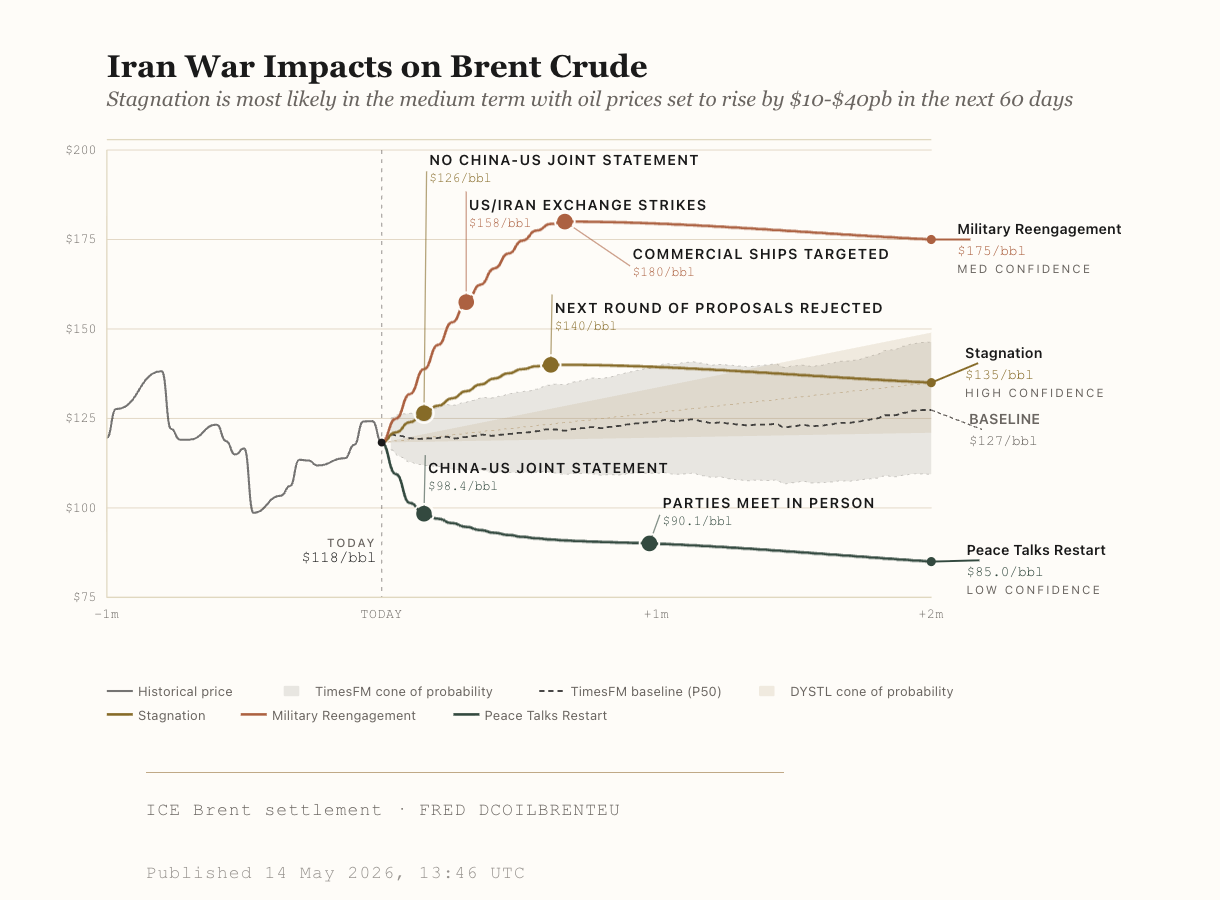
The sequencing impasse has not moved. Iran's sovereignty demand over Hormuz is incompatible with any US-acceptable settlement, and Netanyahu's uranium removal condition forecloses a deal that does not involve physical stockpile elimination Iran will not voluntarily accept. Watch whether the Trump-Xi summit produces a joint statement on Hormuz: Chinese co-authorship of a reopening call with operational content would indicate Beijing has decided to use its Tehran leverage, which is the only scenario that shifts the trajectory before June.
The summit's failure to produce a coordinated Chinese pressure campaign on Tehran will confirm the blockade extends through June. Domestic US economic relief measures signal the $35 billion consumer cost is approaching the political tolerance threshold for the administration's base.
The WFP's 45-million-person food insecurity projection materialises if the Hormuz closure continues through June, generating humanitarian pressure on Washington from allies and international institutions simultaneously. Iran's million-job domestic loss figure will intensify IRGC institutional pressure to extract a face-saving exit rather than capitulate.
The Foreign Affairs nuclear analysis establishes the durable strategic problem: a deal addressing enrichment and stockpiles without new centrifuge manufacturing constraints leaves Iran able to reconstitute a weapons-capable programme within six months. Any agreement Trump can credibly claim as a "far better" deal than the JCPOA must address centrifuge technology that cannot be bombed away. That requirement makes a genuinely durable nuclear settlement structurally harder than the current diplomatic deadlock suggests.